Showing posts with label art. Show all posts

Sunday, September 7, 2025

The Repeating Anime Image

 Say if one were to incorporate anime, visually or stylistically, into a traditional printmaking image, e.g. in an etching or lithograph.

Immediately the conceptual critique starts with pointing out juxtapositions and the sort: digital-based image on physical medium, unserious image in a serious medium, etc. 

I am more curious as to what actually occurs in presenting this hypothetical print.

example: presenting the printed image (the edition) in a grid layout.

There is then a similarity, rather than a difference, that occurs: a resemblance between the internet's format for displaying images, particularly when it comes to anime, e.g. google images, image-gallery websites like Pinterest, web or application windows, etc. 

Yandex image search

sidenote: "image-gallery"

Contrast: if the same presentation were to be done with a famous fine-art painting.

The resemblance here sources more from a difference: we think about reproducing art as consumable products, of the gift shop in a museum, etc., things that are generally deemed "bad" or unlike the "proper" purpose of art.

The difference happens because an individualistic image is reproduced and displayed with its copies.

Each print or image is now a "fake" because "there shouldn't be" multiple of them.

Another option: if the same presentation were to be done with an original drawing, a typical printmaking image.

This just appears as a print qua multiples. When we see a print, we know there are (or there "should be") multiples. If we saw the entire edition laid out, this just reaffirms the same fact.

A source of tension here, in a manner like the reproduced painting example, would have to stem from thinking an image shouldn't exist as a multiple at all, e.g. someone who thinks lowly of printmaking.

I am not really interested in this pathway of accepted or not-accepted art mediums, but it does exist.

Also, more things happen in these acts, obviously. I am just sticking to what I find to be either the main one, or the most initial (perhaps simplest?) one.

No difference occurs in the first example; surface-level, it is because anime images "should" be displayed like that, or we expect them to be. The reason for this, which would be a truer reason for the lack of difference, is because of the anime style. It's not individualistic, it's a style, meant to be reused and reproduced as if a formula. The anime face has a structure so solid and self-referential, it operates like a rule we don't realize as one (I emphasize "like" because I do not want to say that it is a literal rule, or even a delusional convention). It's as if there are "anime physics", a fully functional world of its own; compare to the treatment of the internet as opposing real-life, in the terms online vs. "irl".

...and so on.

In a simple way, it is because anime is not individualistic.

Perhaps this is what people focus on when they have an aversion to anime in art, usually presenting as a worry that a style traps everything into a mass-producing formula. While the lack of individualism is true, it doesn't really occur as a negative when engaging in anime-things. For instance, on the flip side, this style produces individual characters, and I do not mean literal characters in media. I am talking about using the internet as a child circa 2010's, I am talking about "otaku culture" spaces (which is actually a really good example for abstract anime).

I am talking about indie music ("doujin music") that isn't anime music, i.e. not an anime opening or theme song, but always has something to do with anime in a more general way: the usage of anime drawings for its visuals, sometimes singers present as an anime character instead of showing their face, etc.

Taishi - The Personalizer
For better or for worse, this has been the internet I've been algorithmically granted since day one.

What I mean to say is that within anime, within the rules of the anime, some sort of visual-based individualism is created (bad phrasing, I do not know what to call it). In fact, such personality and character is created by these very tropes/rules: to those who understand, we know what sharp, upturned eyes mean as opposed to round, droopy ones.

Fujibayashi twins (Clannad) + Kagami twins (Lucky Star)

What of this combination of individualism and sameness? How does this differ than, say, placing a judgement/assumption on someone in real life based on their appearance (and being correct)? Perhaps in that the latter isn't expected to be true. By this I mean, it isn't as if in anime a character is guaranteed to follow a trope, same way no one in real life is guaranteed to follow their respective stereotype. But in anime, in its fiction, are there implications for following/breaking a trope? Is there a realness beneath the trope-surface? Is the care in our act of judging or realizing one's character placed elsewhere?

On the example of using the internet as a child, of typing in 'cool anime girl' into google images: a care is placed on the visual aesthetic, a product of understood trope and "rules", a product that is real/true within the context of fiction.

'cool anime girl' google images w/ date filter

Compare to being enthralled by the coolness of a real person, of someone in a similarly unreachable role, for instance, like a celebrity (idol). There is an urge to say "but there's a real person there, there's more to them than that!" based on the truth of the personal, based on an understanding of the delusion of all conventions and rules needed to elevate them so such a status of 'celebrity.' 

A fictional character's unreachable status is the truth; so is it that such an indulgent care and focus on aesthetic-based characteristics is okay, as it aligns with what is true (aligns with the operation of anime)?  

I find a strangeness located in the fact that such a deeply felt understanding of 'character' or 'personality' is  realized from a character's aesthetic tropes (as tropes/stereotypes are surface-level), e.g. the deeply personal commitment and love idol-game players have towards their favorite characters (there is no derogatory tone here, I mean the same love a normal, "normie", person holds for their favorite character of The Office). Is this act inherently aware of its own operation, i.e. the necessity of the personal/subjective in connecting with fiction, in reading "truths" in fiction, etc.?

Compare "knowing" a person with knowing a fictional character. The urge: 'can we truly know a person?' and etc. Can we truly know a character? Perhaps not as a created artform of its author, but as a character? Yes. There is nothing real beneath our forever surface-level understanding and judgement.

Perhaps we are solely dealing with the surface, with the fantasy of fiction, and therefore such equally surface-level actions (judgement, assumption, idolizing) become true or work.

In other words: The subjective surface is what there is, we reach the surface subjectively, we know it.

This is part of why the concern of an anime style in art is misplaced (I am not saying the sense of the opinion cannot be had, but that the critique looks at the wrong area). Anime in this view is viewed as a style, as its surface rules and tropes themselves, minus any meaning or implication or any connection: big eyes, sharp chin, girly face—End the sentence! End the thought! It's getting angry at the very physics of something and nothing else.

***

So back to the original premise (as this has gone wildly off-track): to repeat the anime image does not threaten it, because we understand its own repetitive, fake physics. At the same time, the implications of what goes on in this image (the same area our assumptions of personality play in) is not lost either. Besides losing the allure that comes with singular images, it's quite indestructible. 

Compare to the example of reproducing a fine-art image, or to repeat an image of a real(istic) person. Their individuality (the implications of the image, the personality understanding) is killed off. Its own physics and validity of existence are cut through: you are not supposed to exist as a copy, you are now fake, fake is not real. 

***

As always, I have no idea what any of this writing implies or leads towards.

I have left out analysis of printmaking as an art medium, because this turned into a different topic. 

Monday, June 9, 2025

Quote from 'The Hidden Order of Art'

"Gombrich's great achievement to have finally broken the 'externality' illusion that had invested the conventional schemata of Western realism with objective reality. (One wonders whether Wittgenstein would have tried to give objective validity to the logical structure of language had he not-- somewhat naïvely-- accepted that the elements of a picture had the desired objective structure, which, of course, they had not.) According to Gombrich the coherence of a picture rests on entirely conventional schemata which the artist has learned to read as though they were as objective and real (realistic) as reality itself. The rules of realistic picture making were the rules of a game played according to certain conventions that were constantly modified like the rules of a game. Had Wittgenstein known Gombrich's ideas he would have been able to synthesize his older 'picture theory' of logical language with his final 'game theory' of language. Understanding the flexible rules of learning to play the game accordingly is all there is to the objectivity of images both in the visual arts and in language."

-- The Hidden Order of Art; Ehrenzweig; pg. 111

Sometimes I think about exactly what a book will eventually say or reference, at least vaguely, and when I see it all connected out of nowhere in a manner far better than any inkling I had prior, and I throw my hands up in the air. Or, which is the same thing I am describing actually, I hope to find something relevant in an unplanned location (e.g. a random book) and it ends up being far too relevant. Same reaction. Thank you Burren College library.

Sunday, June 8, 2025

Thought on immersion in art

A thought I wrote earlier that I never finished:

I wonder if the most typical "real" appearing artists, those who are so immersed in their own art-making, who seem to have such a high level of love for the game, are this way because of (or partially) a belief in what they do. They 'feel" strongly about it, in a "there is something to this" sort of way. They do not need to be conscious or unconscious of any of this (I always assume most I observe are unconscious, but who knows).

It would be entirely possible to be assigned to make an artwork and provide it with a highly complex and substantial conceptual existence, one that elevates that artwork to a truly respectable and "real" level. Repeating an artwork, or a manner of art-making, without any real thoughts behind it may operate in a similar way.

But isn't there something different, something special in those who believe in their art so strongly? Not that they need to have a sense of importance or find their art to be special, or find their art to be art at all... It may be similar to when you meet someone overflowing with genuine confidence. There just is something different about them, not that they have a certain personality or behavior, but they just do things that are genuine, feel so attached to themselves; when you know that someone has a strong sense of self, for instance.

I wanted to expand on how I observe others to be more immersed in their art, which then speaks to a more general concept of immersion. I'm not sure what made me focus on 'belief' first rather than immersion; I have been recently thinking about what having a strong conviction about something means, or questioning why that is so significant, which more or less is the same thing as having a belief.

Monday, May 26, 2025

Questioning image-making

For a while now I have been wondering how people go about making art, specifically in coming up with imagery. I would say I have lost track of how to make art, although I cannot remember when (if at all) I did know. I do know, though, that I was never unconscious about this topic.

What I mean is that when observing others, which of course operates by assumption, people seem very immersed in their image-making. A lot of people come up with something immediately and on-the-spot, although not everyone does this. I have always been impressed with those who can doodle something when told to. I cannot do this and have never been able to do this.

But I realize that when going about my projects in art school so far, I haven't really "waited until inspiration struck" either. I wait, I just don't remember inspiration. I sit down, I think by way of writing some things down, and the planning stage comes about in the form of a line-by-line succession of notes, bullet points, or statements. This leads to this, to that, and that explains that part, which means its this... and then I stumble into an image somehow.

The reasoning for the art is realized prior to making it (although the more "psychoanalytic" facts and reasonings about the art still come later, if that matters). I create the art's logic before the art is crafted.

I think the image exists as only a sense, though. I never picture something clearly in my head, even though I would be entirely able to. I know I purposefully leave things open, I enjoy generating the image while drawing it. I need to decide on things only after observing instances within the process. Plus, I think openness has its advantages.

the architectural structures depended on
which marks where already made

It is the way of the stereotypical painter that fascinates me because I am not one. I have an easier time coming up with architectural imagery. It's not that I don't know how to draw anything else, I just struggle to make anything else into an image-scene (an architectural drawing becomes an interactive 3D model/space in my head). If I set about drawing a person, I draw a person, and then it ends quite quickly. I don't know how to merge the object or person into a space. I only know space itself.

Or, it isn't about what I know/don't know, but that anything else results in something different. I fear I have a tendency to become illustrative far too quickly, which is why I don't consider myself as sophisticated or fine-artsy as most people (and I don't want to make illustrations, so I think this is a flaw of mine). I can merge space with object/person, but it becomes illustration. That is why I am constantly asking how to be a painter.

Painters I've observed just get "so into" their process and image, with such a level of certainty, but appear pretty unaware of what's going on. I mean that they are unconscious in a good way. Immersion surrenders the act of stepping-back and viewing something objectively or critically. I suppose this is why people can overwork an image, or get too stuck on one part, or not see something others can.

If we treat overworking or lack-of-seeing as symptoms, then it becomes strange, because I have memories of doing those things prior to college. Back in high school, when no one properly took art seriously, but we all believed we were doing something vaguely serious, and everyone worried about "same face syndrome" and made jokes about the "pain" of learning anatomy because we thought those were the things you were supposed to worry about. However, if I think about the very few art assignments I made in high school, I was distinctly not immersed in them, save for the moments where I got lost in the process of repetitive crosshatching (is this the only time I was immersed? Where I remember the "symptoms"?).

And I think I should make a quick confession about the fact that I would draw anime art starting at age 10, and just about any drawing in this I was extremely immersed in, particularly in digital art. But this is shameful, and it actually goes nowhere, so I'm scrapping it aside (although the topic of the digital work field/space is interesting and I would like to get to that sometime).

I must go farther back and think about childhood. I remember the first time I decided to draw from life; I think I had seen some still-life in the museum and developed an inkling on how it was made (I had no idea what art terms meant). Before then, I had been pausing the television and copying it. While watching television, I would watch the outline of each cartoon character, and I would envision curving one of those rubber dividers used in landscaping (I saw my neighbors redo theirs and was fascinated by them, for some reason) to make the outlines.


This became an obsession as strong as my hobby of clenching my feet when the car passed over the white dashes that divided street lanes. I attribute my natural tendency to be good at rhythm games (specifically ones that have linear notes landing on a horizontal hitbox) to this. Similarly, when I went about drawing from the cartoons, I was really good at copying the outlines.

And after this saga, I lost the desire to ever draw something made up without knowing why (in hindsight, it was traded for making my own anime drawings).

Prior to it, like any kid, I did make imaginative drawings. I remember the process for these well: I had an idea and thought I should draw it, and so I drew whichever "thing" was in my head, and the more narrative the idea was, the more I developed a scenery around it. I often made stories along with my drawings and made my mom write them down on the backside. In particular, because they were the drawings I liked making the most, I drew a lot of robots, though none of them were ever placed in a space. My mom assumed there was a story to these too, so there is a page somewhere where I claim a robot's ability was to clean the house and take out the trash (I like to think I said this to amuse my mom, which worked), but I remember this being very forced, and the robots held a special place in my mind in some manner.

Basically the process is as follows: some pre-held sense or idea; depiction of the main subject or an outline of the scene; development of subjects; determining interaction between subjects; depiction and development of these interactions; continue until a completed scene.

When I force myself to sit down and draw, which was an exercise of sorts in response to my lack of imaginative image-making, I struggle to have any idea at all of what to draw. But when I begin on this process, it goes quite quickly, and the result always surprises me. When I look at the image, I can see how I created its own space/world and where everything falls into place within it, even if it's just a simple sketch. 

the left hand (the pointed finger touching the palm) is the
most visceral to me, because it was the most visceral to make

The only thing I know that happens when I drew this, was "this hand goes here, and it touches this (draws 2nd hand), and it's part of the body so..." It's a lot of 'this and so' instead of 'this means that because.' So I wouldn't say it's the subconscious taking over or anything because I am aware of something and using some sort of logic while making it; I'm just not aware from a third-person or twice-detached perspective. Logic is possible in immersion. It's the logic of the image. Immersion lacks critical logic? It's similar to tunnel vision, isn't it?

***

Of the older painters: how does one go about making up a portrait or landscape? Where and what is the difference in process between making up a portrait/landscape from life, and making up depictions of myths, religious scenes, or just scenes that don't exactly exist in real life? And if it is a more straightforward process (painting a portrait of someone and depicting them as they are), is this less substantial or interesting? I am hinting that people do not find this less substantial, so I am asking why so, and where is the substantialness located.

And then I go right back to thinking about art school. Assuming we have gone over the serious of questions about if this or that kind of art is better, and landing on the easy answer that 'no, nothing is better or worse, at least inherently', but then adding a footnote of 'the more revolutionary or innovative are more interesting, yes', I have to ask what art students are doing (because that is my world; you could ask of professional artists, but that's not my world, and sometimes they get into such a rhythm of making their signature art that you need to observe them in a different manner).

Why do my painting classmates make the paintings they make? What do they think about? How do they come up with these images? I have never asked directly because it doesn't ever come up; I did attempt to ask a classmates who is actually part of visual communications why she made her project, how she went about the idea, what interested her, etc. (it was a book containing anonymous replies to a question about their first love experiences). She didn't really answer. Anytime this sort of question is asked in a class, people are a bit baffled, as if they were asked something they thought was common sense.

Of course I can say that this means I'm not a real artist, and it's probably true. But I still want to have an answer. This also doesn't mean that I think people should explain everything, or have their art be explainable. I have had classmates who make such strange art in such strange, immediate, spontaneous ways, that no one questions them because this strangeness becomes its own explanation.

The closest I've gotten to the location of this question/topic is when people explain the emotion behind their art, or the emotion they put into it. I mean that quite frequently people explain the reasoning behind repetitive motifs in their art, for instance, in terms of concept (no surprise in a conceptual school), but this is a step that occurs after the art. It is located in the after, even if its contents take place elsewhere (the motif occurs during the art, the reasoning before and outside of the art), it is an analysis. I am asking about what occurs in the before (and inside, not outside).

This question is especially true for those who feel so strongly about their artmaking and do things with such a high level of confidence or belief (not that they cannot be self-conscious or doubtful at the same time). I want to see what they are seeing, or see what they are thinking (or think what they are thinking? think in the manner of how they are thinking?)

I haven't really reached any conclusion or real question in this post.


Tuesday, May 20, 2025

On 'abstract': its definitions, "floatiness", and usage in art

Brought on from my last post, I have been briefly questioning the word 'abstract' as it holds such a strong and understandable meaning to me that I find myself unable to define it (unlike other words where I can recall a definition that made sense, and my understanding of the meaning is a bit "choppy", because I have a poor vocabulary).

In an art-related context, clearly, it is meaning the abstraction of an image. Something torn away from its factual, "real" existence; and that encompasses qualities of being concrete, collectively defined and agreed as fact, and so on. Like a verifiable piece of evidence, something empirical, a factual existence has this sense or assumption that we can return to it (is this why a fallen building or a closed restaurant shocks us so much?). Something abstract cannot, or it at least doesn't hold the assumption that it can be returned to.

I wonder if this verifiable 'returning-to' is actually not so true, that is, either the abstract-object (e.g. idea) can be returned to and the real-object can as well, or neither of them can, perhaps by way of a change occurring (although I already don't like this latter half). Or, something like the abstract-object and real-object aren't too different in regards to their existence towards us, the existence that we can return to, touch, or interact. When we return to a real-object, are we returning to the object itself or an idea of it? But this has already become quite a pointless question...

What I mean to get at is that the abstract existence of something is different than its real or concrete existence, at least in some manner, such as how we interact with it or believe to interact with it. When someone's idea is quite abstract and he is explaining it to us, we might understand him or believe we understand him very well, but it is often difficult to "return" to the idea and picture it again (for the sake of analysis, reference, etc.), and so we ask 'Well that's too abstract, so can you give an example or something?'.

I suppose what matters in terms of the integrity of our interaction is the fact that we can understand this abstract idea without interacting with it the same way we do for the real-object; e.g. we don't need to "see" it with our own eyes to understand it. This is unusual compared to the real-object. There is no point in questioning the building in front of us because we see it, and while you can question this, it just has no point (I don't have the care to unravel this entire topic on certainty). Our belief and trust in the empirical senses is just that high, the integrity of our interaction with a real-object is great. The abstract's is not due to the very nature of its existence (I am not saying to raise its integrity to be as high, although I claim this lack of integrity is not a bad thing, because even I can fed up with someone's overly abstract explanation).

And the thought I had was how with the great existence of abstract art, which interestingly does hold a high integrity, perhaps by way of some sort of self-verification, the meaning of 'abstract' takes on some object-like existence. 'Abstract art' is art where the imagery is not of a represented object, it is abstracted. The head of a person, for instance, has been twisted and reshaped into a circle. We know it is a head because by some way or another the art has made us understand that this circle is a head, perhaps in its title or the context clues of its surrounding image. This could happen by way of a "code", some metaphor key of circle=head, rectangle=torso, and so on, but this existence is barely abstract and is also in my opinion quite lame (lame if we are to treat it as special, I have nothing against circle heads).

It seems that this code uses abstraction and creates its own concrete existences within it: circle, head, now draw the line of understanding and meaning to connect them. This immediately becomes strange. If abstraction makes it so that we cannot "return" to concrete objects, then why and how did it just create its own concrete objects of returnability? If we were to be abstract purists, this would feel like a cop-out.

But what of pure abstract art, e.g. abstract expressionism, or just really in most existences of abstract work that we don't even question anymore, where there are no recognizable codes? The title of a work where, say, we see multi-colored splatters and unrecognizable shapes, becomes just an additional layer of conceptual context; calling a wild abstract image, "My Mother", isn't a code, it just adds some sort of additional meaning ('Why on earth is it called that?', 'How weird', 'That's how he sees his mom?!') and context (for some reason the artist titled it that way, similar to an event that would spur an artistic creation). Note: I'm not saying it cannot be a code, it just isn't in the regular existence of a code, so if it were a code to us, it functions so fundamentally different than the circle-head key that it doesn't matter.

I wonder with how long abstract art has existed and the name it has made for itself, it has now climbed the ranks to sit at the same definition-meaning level of 'Portrait' or 'Landscape,' despite originally being a descriptive word within art (and we still see this with something like 'abstract landscape'). We know what an abstract work will look like, what it will entail, its history, and how to interact with it (we will interact and "treat" a landscape differently from a portrait, and the same for total abstraction). This suddenly feels so concrete, almost like a coded existence itself, a concrete field of abstract paintings...

And so what happens to abstraction within this? The function of the descriptive of 'abstract'? 

If 'abstract' is the same nature of those floaty-ideas your over-explaining mate loves to talk of, of no returnability, graspability, a slippery nature that never focuses in the sight of our vision, never solidifies in the grasp of our touch, and never specifies in the sound of our hearing, have we suddenly developed an abstract sixth-sense? Where is the floatability in the abstract work? The paint splatter is there, right in front of our eyes, fully specified, fully solidified, and fully focused.

There is an idea that abstract painting is more "real" in regards to the paint, we can see it as paint, it is just paint. Meanwhile, representative painting is less real because we are falling for the illusion paint is giving, we are not seeing the paint for being paint, we are somehow "seeing" a person while looking at paint...

What I mean more so is in the word of 'abstract', less so this practical function of its description within art and so on. The sense from the word 'abstract' is what I am concerned with. I think about how in an intro painting class ('Painting Practice' for any SAIC people), when my teacher assigned an abstract assignment, where it was mandatory to be totally abstract, many people completely missed the mark. Someone painted an urban scene but turned the buildings red, and when questioned where the abstraction was, she said 'Well, the buildings are red!' This shocked me because I was not a 1st year student in this class, and so I felt a violent pull back towards my high school memories. But what also shocked me was the sharp difference in the understanding of 'abstract.'

The correct abstraction assigned was what I've been previously defining, of floatiness, of no codes, of no returnability, and whichever way that applies itself to visual art. The abstraction the classmates were thinking of was a definition closer to 'when the thing is different from how it is supposed to look.'

It is not that this definition of abstraction is wrong, or always wrong, because it is seen with the cartoon: the human is 'abstracted' into a circle with circle eyes and a line mouth, and so on. Is this closer to the circle-head code? Is this definition of abstraction what art ends up really doing, even if we understand its correct existence should be of floatiness? Are we still copping-out?

Note: This is similar to an issue I kept running into when reading Deleuze (in a class) on aesthetics, and his disapproval of abstract art, as he was looking at abstract expressionism and earlier artists like Kandinsky, and disapproved them for just using codes (and is probably why I keep falling back on that word). And I feel this should be mentioned for context. But I do not mean to talk solely within that context, nor take anything from that angle, because firstly Deleuzian aesthetics is not the most fun route to walk down, and secondly I find the route to be too rocky, that is, I can't help but see the problem of coding, yet I can't help but hold faith in abstraction! I think there is something to the idea that Francis Bacon saves and returns the body/head (blah blah...) by using portraiture and not abstraction, but I do not see the rest of this take... And I do not with to ostensively engage with this context any longer!

I should try to locate whichever "problem" I am desperately trying to point at, and this is why I am writing this (I think while writing, and I think in a style similar to generating writing). Summary: I find something strange in the nature of abstract art as a whole, and as a thing (conceptual object). I am suspicious of something in abstraction, and I am concerned with the supposed loss of a definition of abstraction (one of "floatiness").

Why am I concerned? That is what I am trying to figure out.

To ground this, and to finally return to my original reason for writing this (or being reminded to write this) is the example of 'abstract anime'. What do I even mean by this concept (I am not saying it is my concept)? It is not enough to just abstract the anime-face, an abstracted version of the cartoon anime style. Abstract anime is something more, it is this strange floaty concept, and that is why I wrote a post pointing to various sources and claiming they are "anime" (this slang is fitting, actually: it is giving anime), especially sources that shouldn't elicit that. It is closer to the "correct" definition given in my painting class example. It is closer to the word definition.

I just need to figure out why I care about this version of the definition, and further develop whether or not it really is different, and if it is how so, and if it isn't why not, and so on and so forth...

In a less serious and more personal way (as in it may only apply to me, or I will only speak on it as if it applies to me, which is such an interesting usage of language by the way), I would like to approach this floaty version of abstraction. I may be a bit of a purist. I may be trying to make complete sense of something that by its nature is less conceivable (concretely conceivable, "reachable"), which I wouldn't be surprised at. Or, it may also be an attempt to uncover some less conceivable idea that permeates its way into so much more outside of our attention, and I would also not surprised at this.

For what it is worth, in terms of 'abstract anime' and whatever I am trying to develop in that, its usage of the word 'abstract' and its relation to the definition I was referencing in this point is a conceptual existence. And, while I don't have the energy to explain why this is, I think something in that would be useful. Earlier I claimed that wondering if we interact with the abstract idea of an object, even when interacting with its real and concrete existence, was a pointless question; I wonder if this last bit is more so in relation to that...

I should also mention that when I wonder or question, I am not literally asking questions and expecting answers. There is a reason I do not seem to care to go into the history of abstraction or the etymology of the word, and it isn't just my own lack of knowledge and intensely high degree of stupidity causing that, I am just not writing a history book.

***

Picture example: 

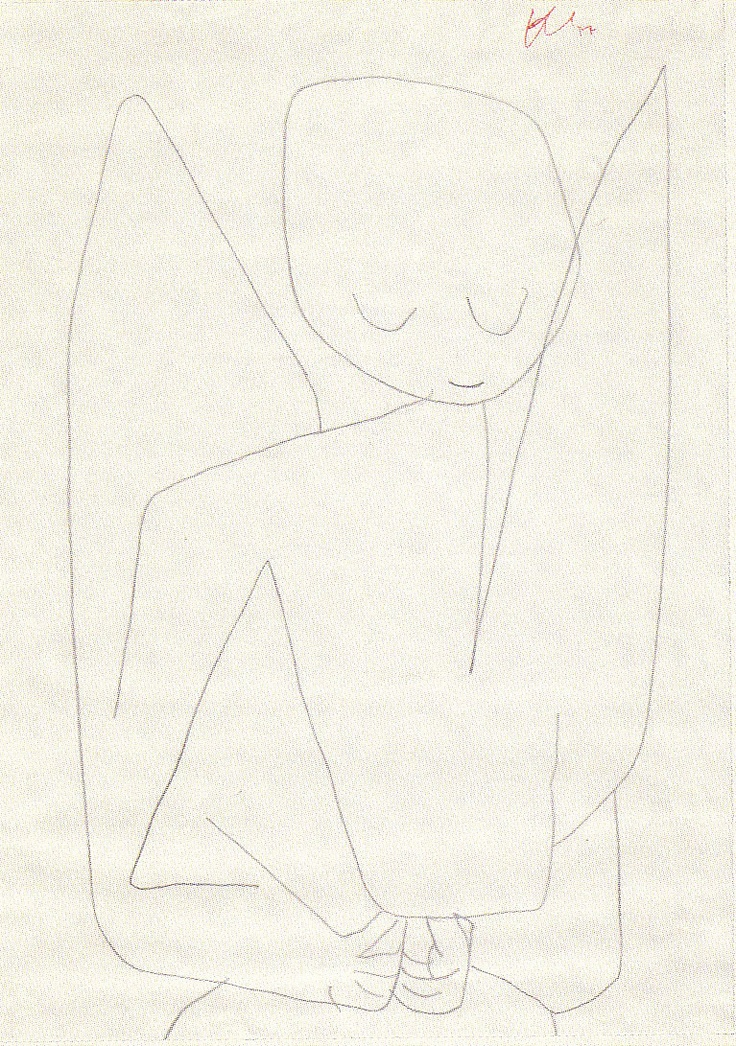
Paul Klee
Little Busters! (Key)


'That's anime', I point to both. What connects them is 'abstract anime'. Yet one isn't anime, and one isn't abstract. 'Abstract anime' is abstract, because it connects these two images, because it is these two images.

Saturday, May 17, 2025

On abstract anime and its examples: intuitive recognition, anime-clouds, and seeing faces in the dirt.

Note: these sorts of posts are speculative and I don't wish to be taken in a serious tone. I just into topics like these from random starting points, and I haven't made up my mind on any of it.

Examples like Teng Yung Han's are very literal, especially the first photo below. It is a clear, literal abstraction of a figure, the lines drag themselves out of place, it's quite modern. The main difference is that in place of the most human-like facial features, there is anime: the wide face, the large eyes, the exact anime facial proportions. If anime is, in only one sense, the erasure of the human features of the nose bridge, the bumps, the wrinkles, the erasure of definition itself, then we can see how such a thing appears here. What is exaggerated is not, say, the near grotesque nature of a human face, but instead the pleasantries of the flat, empty anime face.

Teng Yung Han

Teng Yung Han

There is an exact manner at which these facial features come to be, a specific organization, that I am unable to word well enough (anime is not just 'the large eyes' and I want to avoid this notion as much as possible). It is almost as if the childish, wide proportions of anime developed themselves, all by themselves, so much to where it becomes its own being: it isn't a translation of a child into a drawing, of a person into a cartoon, and so on (I hint at this in these notes).

More has to be developed for me to clearly define what I'm talking about, so I will skip ahead. What matters, in my opinion (I do not think there is just one explanation, this is just the one I'm focused on), is visual recognition. Not similarity of like-ness, nor resemblance; such things are the operations of the end-result objects (in this case, drawn faces) to each other. I am focusing on the other side of the operation: the recognition in the human viewer.

When I say 'Teng Yung Han is drawing anime, because look at the eyes, it's shaped like anime eyes', I am calling out to two objects: Teng Yun Han's drawn faces and the already-defined, already-drawn anime-eye (both the concept, its definition, and the visual thing). This is as if you cut the faces out of Teng Yung Han's drawings, and then cut the eyes out of several different television anime, and put them side by side.

When I say 'this is anime', I am calling out to a concept of anime not necessarily defined. I know what it is, someone else may know what it is (or we think we know what it is, we think we are speaking of the same thing), and this knowing is because of our recognition. We don't need empirical proof to jump to this knowing, it operates at the same speed of intuition, and calls to somewhere in the mind, perhaps. By this, I mean our visual recognition is shaped largely by what we've already seen, by our mental-visual schemas. This doesn't mean it's impossible to empirically prove that something is anime, you can go back on your tracks and hand-select instances from your schema, and then cross compare and so on. But this takes place after our intuitive recognition.

The point is that someone may very well look at Teng Yung Han's drawings as I explain and map them out, and then stop me and go 'Hey, where are you seeing that? Where is the eye?' and I would be very surprised that someone wasn't on the same page as me. I must remember that my eye has been trained to see this sort of imagery because I am so familiar with a certain manner of anime visuals.

Have you ever seen a face somewhere, maybe a cloud or something in the dirt, and look at it with another person who also sees a face? And then when you, for your own entertainment, start to map out what the face looks like, the other person stops you and says 'Oh my gosh, that's the nose? I thought that was the mouth! Now I can't unsee it!" and nor can you unsee it.

*** 

 You are looking for faces in clouds, and I am looking for anime.

Max Ernst

An early example (Ernst) of spotting the anime not-so-anime (but very-much-so-anime!). A note: is this not just the cartoonish face? But there is not a real binary between cartoon (western) and anime.

And then, like a paranoid schizophrenic (crude metaphor), I force you to listen to me as I point out the anime in all of the clouds, and the more pointing I do, the more anime-clouds appear, so fast that I cannot even finish my explanations before I'm labelled as delusional.

Paul Klee

The most reoccurring example in the sphere of the non-anime is Klee. Note: I really should clarify that there is no binary between cartoon and anime in this argument, but there is a clear difference when an image is so general that it envelopes both the stereotypical cartoon and anime (typical of the non-anime examples).

I don't have the time nor energy to break down, image-analysis style, why this brings about my recognition of anime. I do want to share, however, how this sparked my intuitive cloud-identifying vision: I of course was familiar with Klee but less so with his various drawings (this tendency is shared across all things with me), and I wasn't familiar with the angels. I was familiar enough with his style, or more so similar styles of the time, to see the image of this angel on my internet feed and think 'Who is that? Isn't that...?', but what overwhelmed my thinking was the delayed yet impactful sense of 'that's cute.' And it wasn't just me, but whoever shared this image, and whoever was engaging with the image. That is, the image appeared on my feed with a link to a blog sharing someone's revelation with these angels and how cute they were, and while I cannot remember exactly how so (nor would I feel certain enough to retell anyways because it was not in English) but it was likened to something related to anime in some way shape or form. I cannot put my memory-finger on it. The point is, there was a group of people reacting to this image in the exact same manner due to the same mental-visual schemas.

Paul Klee

It is enough to make me drop everything, point, and plead 'But just look at it, how could you not see it?' The delusion grows as the certainty of the intuition grows because they are one of the same.

Paul Klee

Paul Klee


It is always possible to point to examples in the art, to empirical reasoning. Both of the following images have features that seem to be quintessential to the anime face: the wide and often times pointed chin (image 1), or the simplified anime eye (image 2, on the left, it is actually an architectural column of sorts). I am not dismissing the possibility of this act or what it can do, I am just simply uninterested in it, and think that there is a different area to focus and develop (the intuitive/recognition act).

Paul Klee

Paul Klee

Although, it is possible that the intuitive/recognition act makes it so that the empirical reasoning doesn't really matter after all, that is, if it takes one to have a certain schema or to recognize in a certain way to see the same thing, then whatever that thing "truly" is isn't as relevant. One friend saw a nose, one saw a mouth, but it really is just some shapes in the dirt, no? I am uncertain on if this leads me to make some sort of statement, or what that statement would be (I am really not insulting empirical reasoning).

What I am interested in is why we recognize in the way we do, what this recognition does, and how it operates. This can include mapping out the recognition and tracing it back to its schema, which would get us able to hand-select some examples (closer to empirical reasoning). This can also include the opposite direction, going forwards, full-speed ahead and to keep pointing at more and more paranoid anime-clouds until my finger cramps up. And then, just see... see if/what/how...

Believe it or not, this is anime:

Paul Klee

Because this is:

low quality image of an anime character

And this is:

unknown source

That's why this is anime, despite featuring no people:

Hyun Ju Lim

My interest in recognition and schemas, whether forwards or backwards, can also include a focus on how 'anime' (in this specific manner) came to be, and how to deal with its existence.

Much more needs to be thought about, and there is a dire need for things to be put into experimental practice (art-making wise). Perhaps somewhere in this, I will be able to know why I care about any of this.

Tuesday, May 13, 2025

Transcription of notes on: hollow eyes, abstract anime, etc.

 Specifically, I was working on the drawing of the eye; less of an analysis on the anime eye, more of building a rationale for a certain way of drawing eyes I'd been doing (ignore the disturbingly crap drawings, they are more like diagrams).


[the notes were written not in an order from top-down/right-left, so the transcription is reordered.
If you are viewing on mobile, the transcription will likely not format itself correctly.]


"Anime proportions are usually compared to being similar to a child's, giving a younger look...

"But why / or is this true?...

[diagram is depicting how the regular human face turns youthful, it remains oval-based, as opposed to the stylized]


"The eye and face shape (mainly in the jaw) changes, but the anime-style remains... an ability to vary between girlish to androgynous, or young to childish remains... (and follows normal face logic).

"Does it require familiarity to identify these characteristics? Does the visual novel eye (absurdly large) only make sense when one is familiar with the logic of the style?


"Like how in cartoon, all looks non-human or young... but the style is usually extreme in consistency: 

We have come to be unable to not associate a mere addition of 3 lines to mean 'female' (except for SpongeBob...)


"What are the most notable characteristics of anime?: the large eyes, the small (dot) nose... But it seems the size isn't what matters, but the location or its actual shape, i.e. the eyes are located far away, close to the end of the face, the nose is a tiny bump, not an opening with cartilage, etc...

it becomes more anime-like


suggests / fills in as  or 

 ([pointing to the top of the 3rd eye] a more normal sized eye) etc. so it's up to the viewer?


suggests a  , those who are familiar can fill in the blanks


all suggest anime


specifically is an empty, hollow eye. The iris becomes a hole, the eyeball merges with the flatness of the face or skin.


non-expressive eyes are still able to look:

straight on, left, right, etc...


*** PAGE 2 ***


eyes like this follow the 3D shape of the head, but do the irises have shape themselves? 


[The location of the pupil is] similar to a real eyeball 

(it has a weird but real flatness to it, like a flat image under a dome)


The more typical the anime eye becomes at this angle (stereotypical), the flatter and more drawn-on it looks. The iris is now a drawing on a 3D surface (a painted eye on a sculpture)


What of an empty/hollow eye?

A crevice, a hole, an indent? (opposite of the dome, it caves inwards)


the suggestion of an eye, it exists as an indent or crevice of the skin, and appears like a hole (or can be a hole?).

If eyes are the windows to the soul, then these eyes are holes (windows) to an empty soul.

Similarities in my abstract work

I vary between abstract and non-abstract art (I won't necessarily say it's ever "representative", so perhaps it's more so total-abstraction vs. something recognizable) and I realized I've made enough abstract art to find some similarities in them. I don't have the best rationale as to why I should be finding similarities, but since total-abstraction is so expansive in its non-grounded-ness (the abstraction covers the whole image and its construction, like when the 'everything' essentially neutralizes the subject into being 'nothing'), I believe it makes sense to do. Perhaps I'd like to validate total-abstraction and find moments where it is a particular form of image making and not just a big pile of mess.


In particular it was this etching, which has its own reasons for being focused on (for such a graphic medium of lines or the occasional flat/solid aquatint tone, it can be hard to be abstract in an expressive "painterly" way). There are the process-based parts that I had already been aware of: there are lines of structure that builds an architecture within the abstract image (a forced organization), there is an attention to tonal range and where the lights/darks are (from a design perspective).


***


A certain style of brushstroke with an attention to its motion. Of course this has to be made with liquid mediums, which places its shape into the control of the material to an extent, but the result is quite similar across very liquidy materials (pen filler in etching) to more dense ones (mixtures of acrylic and glue, etc.). Most reoccurring is this crisscrossing of slightly curved directions, sometimes zigzag.

While I'm not satisfied by how these shapes come about, the abstract brushstroke typically exists as its own object within the abstract field. It has its own zigzag motion and sometimes an appearance of its own center of gravity (it revolves around a point). In the etching, this shape was made very quickly with pen filler and a toothbrush (of all things), while the example below is made with watered down touche and a brush, and I spent more time overthinking each stroke (so it was constructed more deliberately):


***


Most surprising for the etching is this appearance of a splotchy, sticky, sometimes dragged mark, because I'm not even sure how this got etched into the plate when this imagery usually occurs from stamping or lifting sticky materials. The examples are pulled from acrylic and glue mixtures, and really thick touche.

It's also possible for this to appear in non-splotchy forms, more so as a similar image. I would have assumed it could be achieved by a scratchiness, but I've never really achieved it that way. This charcoal drawing was mostly made from rubbings and starts to mimic this characteristic a bit:


***


Similarly, there is another 'lifting' type characteristic, but with an outline. This usually occurs when a layer of a material is lifted up, so that a darker layer of paint or some other material surrounds the gap/hole. It also happens with collage. My immediate thought is that this is similar to digital imagery: if you take any sort of shape, completely white it out, and then outline it with a black stroke, more so when the shape has an extremely fuzzy but sharpened pixel edge, or is very distorted in its pixels. I knew this shape digitally first rather than in traditional art, and so I was usually referencing its digital existence. In etching, the creation of the shape is also a bit opposite, where it's the outline eating away at an addition of white ground. Interestingly, it works almost the same as the digital method, where the more distorted and "pixelated" (smaller, but solid splotches of dots or lines) the white ground outline is, the more detailed and heavy the black outline is.

The white blotches can be seen in this photo-plate lithograph. The shape itself were created from distortions to a frame in a video (video effects, then photo effects, and so on). So, I would say even these were created naturally, it was up to the quality of the footage and so on. My classmates said the shape was similar to the shape of a country, or meteorological radars, which is an interesting combination of a naturally occurring shape, yet mapped out or generated by something more technological.


***


More conscious to me are deeply engrained scratches. The actual motion of these are something I'm never satisfied with, it's difficult for me to "scribble" mindlessly. Excluding the third example where I scratched into ink to reveal a dry layer of acrylic white paint, these are all engravings made into a surface to then hold ink when wet. I guess its an interest in "carving" without feeling like I'm sculpting or destroying anything; it's carving but with, or through, or maybe resulting in, drawing (and here the perpetual occurrence of "drawing" reveals itself in everything, but that's another topic).

These also sometimes hold ink by channeling a less deliberate stroke. These occur in the etching by its process, but not visually (the scratches where made and etched during a stage where much was already on the plate, and I was open biting it, so that it interfered with deeper areas and widened itself). This example is more so the combination of this engraving characteristic, alongside the shape of strokes (the first one).


***


Another conscious characteristic are straight, horizontal lines made in the middle of a chaotic abstract area. It isn't conscious as in made for a certain purpose, in fact I have no idea why I do it other than "I like to." I'm typically very deliberate, adding lines here and there for a balance, or for architecture, but repetitive horizontal lines are never something I think the image needs, I just feel compelled to do it and once that happens I must do it. It's almost a bit obsessive-compulsive in that regard. The etching is the only case where I tried to control this, because I wanted to play with the deliberate straight-edge tonal lines etchings often have, and probably already made some hand-drawn horizontal lines.

These do appear in more purposeful or representational instances, like in my etchings. Usually to allude to or literally depict ladders, they also do the same for electrical towers and power lines: